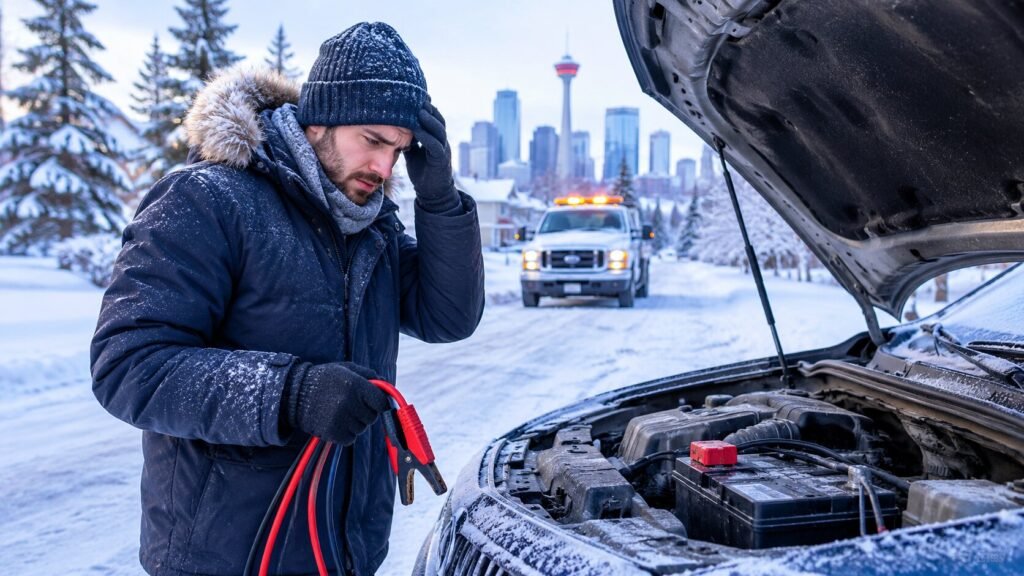
Car batteries die at -30°C because extreme cold slows the chemical reaction inside the battery, cutting its available power by roughly a third to a half, while thick, cold engine oil makes the engine need much more power to start. An old or weak battery cannot cover that gap, so the car clicks, cranks slowly, or does nothing at all.
If you have ever walked out on a frozen Calgary morning to a silent car, you are not alone. Dead batteries are one of the most common winter breakdowns in the city, and most of them are preventable. This guide explains what is happening under your hood, how to spot a failing battery early, and what to do when it is too late. If you ever need towing in Calgary, we cover that too.
What Happens Inside a Car Battery at -30°C?
A car battery does not store electricity like a bucket stores water. It makes electricity through a chemical reaction, and chemical reactions slow down in the cold. At -30°C, three things happen at once:
- The battery produces less power. The reaction slows, so the battery delivers a fraction of the starting power it has on a mild day.
- The engine needs more power. Cold engine oil turns thick like syrup, so the starter motor has to work much harder to turn the engine over.
- Everything else drains the battery too. Heated seats, defrosters, lights, and the heater fan all pull from a battery that is already struggling.
In short, the battery has less to give at exactly the moment the engine asks for more. A healthy battery usually survives this. A battery that is three to five years old, or one that was never fully charged, often does not.
Why Calgary Winters Are So Hard on Batteries
Calgary is not just cold; it is unpredictable. A chinook can lift temperatures well above freezing, then a hard freeze drops them back to -30°C within days. These swings are tough on aging batteries. A few other local factors add up:
- Short trips. Quick drives to the store or the LRT station never give the alternator enough time to recharge the battery after a cold start.
- Outdoor parking. Cars parked on the street or in an open lot cool down fully overnight, unlike cars in a heated garage.
- Heavy electrical loads. Winter driving means more lights, wipers, heated seats, and defrosters running at once.
- Age. Most car batteries last roughly three to five years, and Calgary winters can shorten that.
5 Warning Signs Your Battery Is About to Fail
A battery rarely dies without a hint. Watch for these signs before the cold snap hits:
- Slow, sluggish cranking. The engine turns over more slowly than usual.
- Clicking sound when you turn the key. This usually means there is not enough power to engage the starter.
- Dim headlights or interior lights, especially when you start the car.
- Dashboard battery or check-engine light coming on.
- A battery older than four years, or visible corrosion (white or blue powder) on the terminals.
If you notice any of these, get the battery tested before the next cold snap, not after.
What Does Your Battery Voltage Tell You?
You can check a battery with a basic multimeter when the car has been off for a few hours.
| Resting voltage | Approximate charge | What it means |
|---|---|---|
| 12.6 V or higher | 100% | Healthy and fully charged |
| About 12.4 V | 75% | Okay, but keep an eye on it |
| About 12.2 V | 50% | Weak, recharge and test it |
| 12.0 V or lower | 25% or less | Likely to fail in the cold |
Voltage alone does not show how well a battery performs under load, so a free load test at a service shop is the most reliable check.
How to Prevent a Dead Battery in Calgary Winters
These eight habits make the biggest difference:
- Test your battery in the fall. Most auto shops and parts stores test batteries for free. Replace it if it is weak or more than four to five years old.
- Use your block heater. Plugging in for two to four hours before you start the car warms the engine and oil, which lowers the load on the battery. An outdoor timer helps if you do not want to leave it plugged in all night.
- Park in a garage or sheltered spot whenever possible.
- Take longer drives. Try to drive at least 20 to 30 minutes regularly so the alternator can fully recharge the battery.
- Turn off extras before starting. Switch off the heater fan, lights, heated seats, and radio so all the power goes to the starter.
- Clean the terminals. Corrosion blocks the flow of electricity. A wire brush and a baking soda-and-water mix work well. Disconnect the negative cable first.
- Use a battery maintainer if the car sits for days at a time. A trickle charger keeps the battery topped up.
- Pack a winter kit. Keep jumper cables or a portable jump pack, a blanket, a phone charger, and gloves in the car.
What to Do If Your Car Will Not Start at -30°C
If the engine will not turn over, follow these steps:
- Stop cranking. Repeated attempts drain what is left in the battery and can overheat the starter. Wait a minute between tries.
- Turn off all accessories and check that the dome light and headlights are off.
- Check the terminals. Make sure the cables are tight and not badly corroded.
- Try a jump start if you have cables and another vehicle, or a portable jump pack. Connect red to the dead battery’s positive terminal, red to the donor’s positive, black to the donor’s negative, and the last black clamp to bare metal on the dead car, away from the battery.
- Let it run. After a successful jump, drive for at least 20 to 30 minutes to recharge the battery.
Do not jump-start a battery that is cracked, swollen, leaking or visibly frozen. This can be dangerous. Call a professional instead.
If you are not comfortable with any of this, a roadside battery boost and jump start service in Calgary can get you running without you standing in the cold, and our roadside assistance team can handle other common problems like flat tires, lockouts, and fuel delivery.
When a Jump Start Is Not Enough
Sometimes the battery is simply finished, or the problem is something else, like a bad alternator or starter. In that case, you need a ride to a shop, not another jump. A tow truck in Calgary is the right call when:
- The car jump-starts but dies again right away.
- The battery is cracked, leaking or frozen solid.
- You smell burning, see smoke or hear grinding.
- You are stuck on a busy road such as Deerfoot Trail or Stoney Trail, and it is unsafe to wait.
A few tips for a smooth tow:
- Electric, AWD and lowered vehicles should ride on a flatbed to avoid drivetrain damage.
- Stuck in a parkade? Tight clearance needs the right equipment, so ask about underground parkade towing.
- Slid into a snowbank? Read our guide on what to do if you are stuck in snow in Calgary, or request winch-out and recovery.
- Not sure what a tow costs? See our Calgary towing price guide, and if you are comparing providers, read what to look for in roadside assistance in Calgary.
In an unsafe spot, turn on your hazard lights, stay in the vehicle if traffic is heavy, and call for emergency towing.
Frequently Asked Questions
Why does my car battery die in cold weather?
Cold weather slows the chemical reaction inside the battery, so it produces less power. At the same time, cold engine oil is thicker and makes the engine harder to turn over. An older or partly charged battery often cannot meet that higher demand.
At what temperature do car batteries stop working?
There is no single cutoff, but a battery loses a large share of its starting power as the temperature drops. At -30°C a battery can deliver roughly half of its normal power, so a weak or old battery may fail while a healthy one still starts the car.
How long does a car battery last in Calgary?
Most car batteries last about three to five years. Extreme cold, short trips and frequent temperature swings can shorten that, so testing your battery every fall is a good habit.
Can a dead battery be revived after freezing?
Sometimes. A discharged battery can freeze more easily than a fully charged one, and a frozen battery may be damaged. If the case is cracked, bulging or leaking, do not try to jump or charge it. A partly frozen battery that is otherwise intact may recover after it warms up and is properly recharged, but have it tested before you rely on it.
Should I let my car idle to warm up at -30°C?
A short idle of a minute or two is usually enough. The best way to warm the engine and recharge the battery is to drive gently. Using a block heater before you start is much more effective than long idling.
Does a block heater help the battery?
A block heater warms the engine and oil, not the battery directly. Even so, it greatly reduces how hard the battery has to work during a cold start, which helps it last through winter.
Can I jump-start my car myself?
Yes, if you have jumper cables or a jump pack and the battery is not cracked, leaking or frozen. Follow the connection order carefully. If you are unsure, it is safer to call a roadside professional.
How much does a jump start cost in Calgary?
Prices vary by time of day, weather, and location. A reputable provider will give you a clear quote and arrival time before sending a truck.
Need Help Right Now?
If your battery has already died, you do not have to wait in the cold. KTC Towing offers 24/7 battery boost, roadside assistance and tow truck service across Calgary, and we give you a quote and arrival time before we dispatch. Call (587) 435-0770 or message us on WhatsApp, and stay warm while help is on the way.