Choose a flatbed if your vehicle is all-wheel drive (AWD), four-wheel drive, electric, lowered, luxury, or damaged. Choose a wheel-lift tow truck for a standard front-wheel or rear-wheel drive car that needs a fast, short city tow. When in doubt, a flatbed is the safer choice, because it carries your entire vehicle off the road.
When you search for towing Calgary drivers can trust, the truck matters as much as the company. The wrong tow truck can strain your drivetrain, scrape a low bumper, or slow your recovery. This guide explains how each truck works, where each one fits best, and how to tell which one your vehicle needs.
What Is a Flatbed Tow Truck?
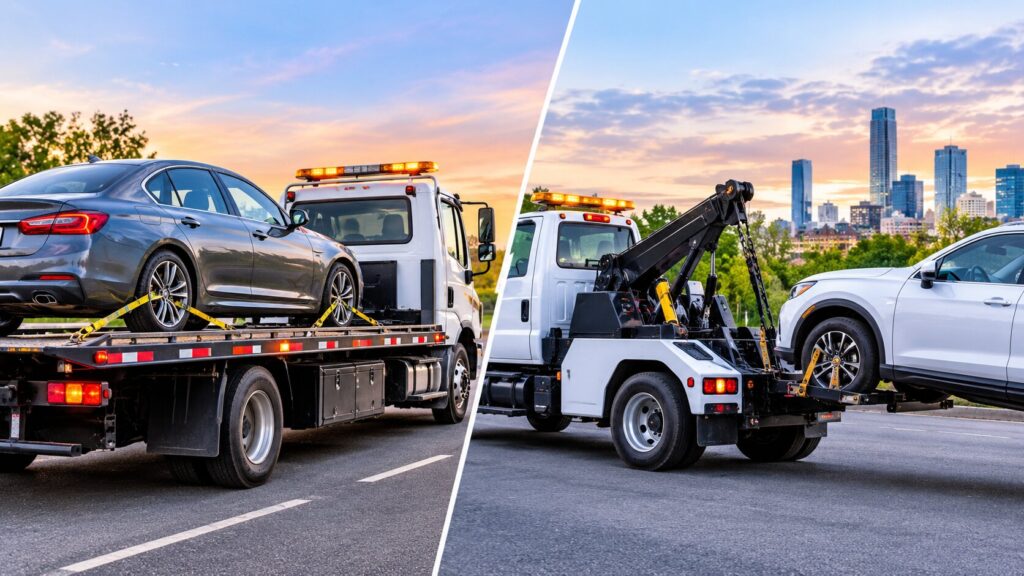
A flatbed tow truck, also called a rollback, has a long flat deck that tilts and slides down to ground level. Your vehicle is winched onto the deck and secured with tie-down straps. During transport, all four wheels are off the road.
Because the vehicle is carried rather than pulled, no part of the drivetrain, suspension, or transmission is stressed while moving. This is why flatbeds are the standard recommendation for valuable, delicate, or damaged vehicles.
Flatbed towing is best for:
- AWD and 4×4 vehicles
- Electric and hybrid vehicles
- Lowered, sports, and luxury cars
- Vehicles with accident damage, flat tires, or broken axles
- Motorcycles and equipment that need level, secure loading
- Newer vehicles you want to protect from any wear
If you need this kind of tow, see our flatbed towing in Calgary service page.
What Is a Wheel-Lift Tow Truck?
A wheel-lift tow truck uses a metal yoke that slides under the front or rear tires and lifts that end off the ground. The other two wheels stay on the road and roll behind the truck.
Wheel-lift trucks are smaller, quicker to hook up, and easier to maneuver. That makes them very useful in tight spaces such as back alleys, downtown streets, and parkades where a full-length flatbed may not fit.
Wheel-lift towing is best for:
- Front-wheel drive or rear-wheel drive cars with working wheels and drivetrain
- Short city tows
- Tight spaces with low clearance or sharp turns
- Quick removals, such as parking violations
For low-clearance locations, read about our underground parkade towing service.
Flatbed vs. Wheel-Lift: Side-by-Side Comparison
| Feature | Flatbed | Wheel-Lift |
|---|---|---|
| Wheels on the road | None (all four lifted) | Two (the other two roll) |
| Best for | AWD, EV, luxury, lowered, damaged vehicles | Standard 2WD cars, short city tows |
| Risk to drivetrain | Very low | Higher for AWD and some automatics |
| Tight spaces | Harder to maneuver | Excellent |
| Damaged vehicles | Ideal | Not always suitable |
| Highway and long distance | Preferred | Possible for suitable vehicles |
Which Tow Truck Does Your Vehicle Need?
Use this simple guide to decide.
1. Is your vehicle AWD or 4×4?
Use a flatbed. In AWD systems, all wheels are mechanically linked. Rolling only two wheels while the other two are lifted can strain the drivetrain.
2. Is it an electric or hybrid vehicle?
Use a flatbed. Many EV manufacturers advise against towing with drive wheels on the ground, because rolling wheels can feed power back into the motor and cause damage. Check your owner’s manual and tell the dispatcher your exact model.
3. Is the car lowered or a luxury or sports model?
Use a flatbed. Low front bumpers and splitters can scrape on the angle of a wheel-lift hookup.
4. Is it damaged from a collision or mechanical failure?
Use a flatbed. If a wheel is broken, a tire is flat, or the axle is damaged, a vehicle cannot safely roll behind a wheel-lift. After a crash, our accident recovery service sends the right truck for the scene.
5. Is it a standard 2WD car that needs a short, quick tow?
A wheel-lift works well and is often faster to dispatch.
6. Is it a work truck, RV, or bus?
You may need something bigger than either option. Learn more about heavy-duty towing.
Why Calgary Conditions Matter
Local conditions affect which truck is the best fit.
- Winter: Calgary’s snow and ice can turn a short tow into a recovery job. A vehicle stuck in a snowbank often needs winch-out and recovery before it can be loaded onto any truck.
- Highways: On fast roads like Deerfoot Trail and Stoney Trail, a flatbed’s secure, fully lifted load is a safer way to travel.
- Parkades and downtown: Low ceilings and tight turns often make a wheel-lift the practical choice.
- Large city: Distance matters. Longer tows are usually better on a flatbed, especially for out-of-city jobs. See our long-distance towing options.
Does the Type of Tow Truck Affect the Price?
It can. Pricing for towing Calgary customers pay usually depends on distance, vehicle type and size, time of day, weather, and special needs such as winching or parkade access. A flatbed can cost more than a wheel-lift for the same distance because of the equipment and loading involved. The extra cost often prevents expensive drivetrain or bumper damage, so the right truck is usually the better value. Always get a clear quote before the tow truck is dispatched.
Common Mistakes to Avoid
- Assuming any tow truck will do. Always tell the dispatcher your vehicle’s drivetrain, such as AWD, 4×4, or electric.
- Not mentioning damage or modifications. Lowered suspension, a flat tire, or a damaged wheel all change which truck is safe.
- Choosing only on speed. The quickest truck is not always the safest for your vehicle.
- Skipping the owner’s manual. It states the manufacturer’s towing recommendations, especially for EVs and AWD vehicles.
What to Tell the Dispatcher When You Call
To get the right tow truck Calgary dispatchers can send on the first try, have this ready:
- Your exact location, plus direction of travel and nearest exit if you’re on a highway
- Vehicle make, model, and year
- Drivetrain: FWD, RWD, AWD, 4×4, or electric
- What happened: breakdown, accident, flat tire, or stuck in snow
- Where you want the vehicle taken
Frequently Asked Questions
Is flatbed towing better than wheel-lift towing?
Flatbed towing is safer for AWD, electric, lowered, luxury, and damaged vehicles because all four wheels stay off the road. Wheel-lift is fine for standard two-wheel-drive cars on short tows.
Can you tow an AWD car with a wheel-lift?
It is not recommended. AWD systems link all four wheels, so rolling two of them can damage the drivetrain. A flatbed is the safer option.
Should an electric car be towed on a flatbed?
Yes, in most cases. Rolling the drive wheels on the road can damage the motor and related components. Check your owner’s manual and tell the dispatcher your model.
Which tow truck is better for tight parkades?
A wheel-lift is usually better in low-clearance or tight spaces because it is shorter and more maneuverable. Some parkade jobs also use low-profile equipment.
Is flatbed towing more expensive?
It can be, depending on distance, vehicle, and conditions. The added cost often protects your vehicle from damage. Ask for a quote before dispatch.
What if I am not sure which truck I need?
Describe your vehicle and situation to the dispatcher. They will recommend the right truck. If you are unsure, a flatbed is the safest default.
The Bottom Line
The right tow truck depends on your vehicle and your situation. Flatbeds are the safest choice for AWD, electric, lowered, luxury, and damaged vehicles. Wheel-lifts are ideal for quick, short tows of standard cars and for tight spaces. Telling your dispatcher the full details helps you get the right truck, the right price, and a damage-free tow.
Need a tow right now? Our team handles emergency towing across Calgary, 24/7. Call (587) 435-0770 or contact us for a quote before the truck is dispatched. For more help, explore our other towing and roadside services.