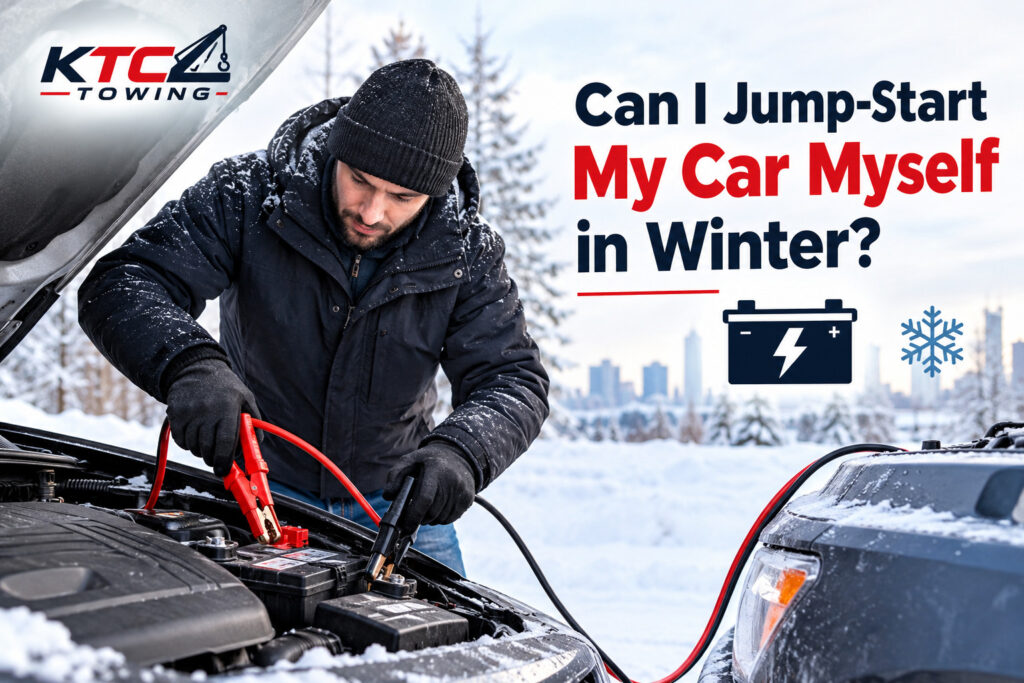
Yes, you can usually jump-start your car yourself in winter if you have jumper cables, a second vehicle with a healthy battery, and the battery isn’t frozen, cracked or leaking. If the battery looks damaged, you smell rotten eggs, or you’re unsure, don’t try it. Call a professional Calgary jump start service instead.
Cold weather is hard on batteries. When it’s -25°C in Calgary, a battery can lose a large share of its starting power while the engine needs more power to turn over thick, cold oil. That’s why so many cars refuse to start on the coldest mornings.
Why Car Batteries Fail in Winter
- Cold reduces battery power. The chemical reaction inside the battery slows down in low temperatures.
- Engines need more power. Cold oil is thick, so the starter has to work harder.
- Short trips drain batteries. Heaters, heated seats, defrosters and lights use power, and short drives don’t give the alternator enough time to recharge.
- Age matters. A battery that is 4–5 years old is much more likely to fail in a cold snap.
- Lights or accessories left on can finish off an already weak battery.
Signs Your Battery Needs a Jump
- The engine cranks slowly or makes a clicking sound
- Dashboard lights are dim or flicker
- Headlights are weak
- The car doesn’t respond at all when you turn the key or press start
- The battery warning light is on
Can You Jump-Start a Car in Cold Weather?
Yes, but winter adds a few risks. Before you connect any cables, check these first:
Do NOT jump-start if:
- The battery case is cracked, bulging or leaking
- You can see ice or frost on the battery casing
- You smell rotten eggs (sulphur), which can mean the battery is damaged
- There is heavy corrosion that makes the terminals unsafe to touch
- You’re unsure about your vehicle type, especially a hybrid or electric vehicle (check your owner’s manual)
A frozen battery can be dangerous to jump. If you suspect it’s frozen, leave it and call for help.
What You Need
- Jumper cables (thick gauge, in good condition, long enough to reach)
- A second vehicle with a healthy battery, or a portable jump starter
- Gloves and eye protection
- Your owner’s manual
How to Jump-Start Your Car in Winter: Step by Step
- Park safely. Place the working vehicle close, nose to nose or side by side, without the two vehicles touching. Turn off both engines, apply the parking brakes and switch off lights, heaters and radios.
- Open the hoods and find the batteries. Some cars have the battery in the trunk or under a seat, and the manual will show jump points.
- Connect the red (positive) clamp to the positive (+) terminal on the dead battery.
- Connect the other red clamp to the positive (+) terminal on the good battery.
- Connect the black (negative) clamp to the negative (–) terminal on the good battery.
- Connect the last black clamp to an unpainted metal surface on the dead car’s engine block or frame, away from the battery. This reduces the risk of sparks near the battery.
- Start the working car and let it run for 3–5 minutes. In very cold weather, give it a little longer.
- Try to start your car. If it doesn’t start, wait a couple of minutes and try again.
- Remove the cables in reverse order, starting with the black clamp on the metal surface, then the other clamps.
- Keep your car running for at least 20–30 minutes, ideally on a longer drive, so the alternator can recharge the battery.
Common Winter Jump-Start Mistakes
- Letting the clamps touch each other while connected
- Connecting cables in the wrong order
- Trying to jump a visibly frozen or damaged battery
- Turning the engine off right after it starts
- Repeatedly cranking the engine, which can overheat the starter
- Ignoring a battery that keeps dying, which usually means it needs replacing
When Should You Call a Professional?
Self jump-starting is fine for a simple dead battery, but call for help when:
- You don’t have cables or another vehicle
- You’re stuck in a parking lot, underground parkade or roadside
- It’s extremely cold and you don’t want to stay outside
- The battery is frozen, leaking or damaged
- The car won’t start even after a jump
- You drive a hybrid, EV or luxury vehicle with special jump-start procedures
- It’s dark, snowing or unsafe to stand near traffic
A professional Calgary jump start service arrives with the right equipment, tests the battery and charging system, and can tell you whether you need a replacement. Many drivers search for jump start Calgary or a battery boost Calgary service in exactly this situation.
How to Prevent a Dead Battery This Winter
- Test your battery before winter, especially if it’s over 3–4 years old
- Clean corroded terminals
- Park in a garage or use a block heater if possible
- Turn off accessories before shutting off the engine
- Take longer drives occasionally to fully charge the battery
- Keep jumper cables or a portable booster in your trunk
- Replace a weak battery before it leaves you stranded
Frequently Asked Questions
Can I jump-start my car by myself in winter?
Yes, if you have cables and a second vehicle (or a portable jump starter) and the battery is not frozen or damaged. Follow the correct connection order and keep safety first.
Is it dangerous to jump-start a frozen battery?
It can be. A frozen battery may crack or leak, and attempting to jump it can be unsafe. Don’t try it, and call a professional instead.
How long should I run my car after a jump start?
Aim for at least 20–30 minutes of driving. A longer drive is better, especially in winter when the battery is already stressed.
Why does my car keep dying after a jump?
It usually means the battery is too weak to hold a charge, or there’s a problem with the alternator or charging system. Have it tested.
How much does a jump start service cost in Calgary?
Prices depend on the provider, time of day and location. Ask for the total price before the technician is sent out.
What is a battery boost?
A battery boost is a quick power transfer that gives a weak or dead battery enough charge to start the engine. A professional service uses a portable booster and may also test the battery.
Can you jump-start an electric or hybrid car?
Often yes, since the 12V battery can usually be jumped, but procedures differ. Check your owner’s manual or ask a professional.
Can I jump-start my car in the snow or rain?
You can, but be extra careful: keep the clamps and cables dry, avoid standing in slush near the battery, and don’t proceed if conditions aren’t safe.
Final Thoughts
Jump-starting your car yourself in winter is possible when the battery is in good condition and you follow the right steps. But when it’s frozen, damaged, or the weather is too harsh to stay outside, it’s safer to get help. If you need a battery boost, KTC Towing offers a Calgary jump start service that can get you moving again quickly and safely.